
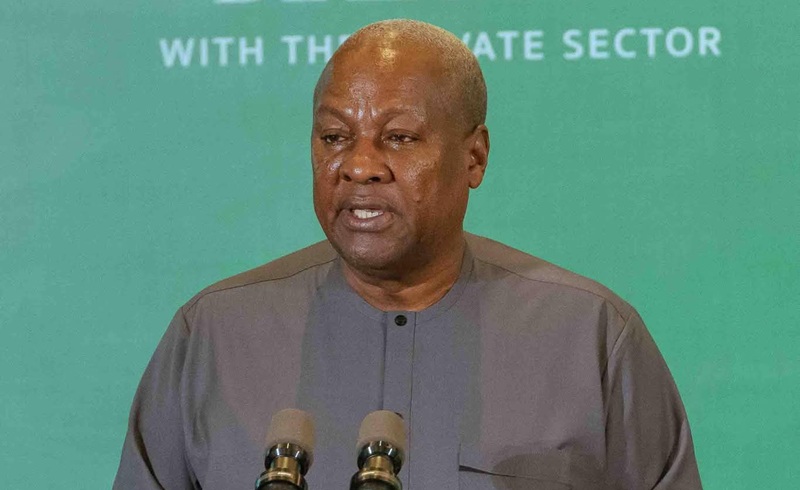
President John Dramani Mahama has mounted a full-scale defence of his government’s decision to reduce the producer price of cocoa, insisting the move
President John Dramani Mahama has mounted a full-scale defence of his government’s decision to reduce the producer price of cocoa, insisting the move was a painful but unavoidable intervention aimed at preventing the total collapse of the cocoa economy, after recently mocking them that he has also been affected by the haircut since he is also a farmer.
Speaking during a high-level dialogue with private sector leaders at the Kempinski Hotel Gold Coast City, the President stated that the cocoa sector had reached a point of extreme financial distress, where maintaining the old pricing structure was no longer sustainable.
The price cut, announced on February 17, 2026, was justified by the government based on deep-rooted financial and structural challenges within the cocoa sector, including mounting debt at the Ghana Cocoa Board, declining productivity, rising operational costs, and weak revenue flows.
According to government, the cocoa industry has long been hindered by inefficiencies, smuggling, aging farms, low yields, and inadequate pricing mechanisms, creating a fragile system that can no longer sustain the previous producer price without risking institutional and fiscal collapse.
The decision immediately sparked nationwide outrage. Cocoa farmers across major growing regions staged protests and issued public statements, describing the cut as devastating to household incomes and rural livelihoods.
Farmer groups warned that the reduction would worsen poverty in cocoa-growing communities, increase school dropouts, and deepen rural economic hardship.
Many farmers argued that they were being forced to pay for failures they did not create, insisting that mismanagement at the institutional level should not be transferred onto producers at the bottom of the value chain.
Licensed cocoa purchasing clerks and buying company workers also joined the outcry, warning that the price cut would directly affect their commissions, operations, and job security. Several purchasing clerks’ associations described the decision as economically crippling, saying lower producer prices would reduce cocoa volumes, weaken purchasing power in rural markets, and threaten the survival of local buying structures that depend on farmer output.
Politically, the controversy intensified when the Minority in Parliament strongly condemned the decision on February 18, 2026, describing it as “cruel” and socially dangerous.
The Minority warned that the policy would worsen poverty levels in cocoa-growing areas and accused the government of shifting the burden of mismanagement, debt accumulation, and institutional failure onto poor farmers who rely on cocoa as their primary source of income.
Civil society organisations and policy analysts also weighed in, questioning governance failures within the cocoa sector and demanding accountability for past financial decisions, borrowing practices, and operational inefficiencies at COCOBOD.
Many argued that without transparency and reform, price cuts alone would not fix the structural problems in the cocoa economy.
As pressure mounted, Government Spokesperson Julius Anthony defended the decision in a media interview on February 19, 2026, rejecting calls for the state to absorb the losses.
He argued that years of accumulated debt, financial strain, and institutional inefficiencies had left the cocoa sector overstretched, making a price adjustment inevitable.
According to him, continuing with the old price regime would have deepened financial instability and worsened the crisis.
Labour groups, including the Ghana Agricultural Workers Union, adopted a more cautious stance, acknowledging the structural crisis in the sector but urging the government to back the policy with clear timelines, farmer-focused reforms, and social protection measures to prevent long-term hardship in rural communities.
Providing a broader historical context, government sources pointed to years of declining yields, weak productivity growth, rising input costs, cross-border smuggling of cocoa beans, and heavy debt obligations as factors that have steadily weakened the cocoa sector.
These challenges, combined with inefficiencies in pricing structures and financial management, gradually eroded the sector’s stability, leaving it vulnerable to fiscal shocks and revenue shortfalls.
Addressing business leaders in Accra, President Mahama framed the price cut as part of a broader rescue and stabilisation strategy rather than a standalone policy.
He explained that the cocoa industry is under severe pressure from falling yields, rising production and transport costs, smuggling, debt servicing burdens, and weak institutional systems that threaten the long-term survival of the sector.
According to him, maintaining the old price regime would have pushed the industry closer to collapse.
The President announced that the decision would be accompanied by wide-ranging structural reforms, including improving efficiency at COCOBOD, reducing waste and financial leakages, strengthening extension services, supporting farmers with inputs, and restoring confidence across the cocoa value chain.
He stressed that the objective is to rebuild sustainability, productivity, and long-term resilience in the sector rather than short-term price stability alone.
Mahama assured cocoa farmers, purchasing clerks, buying companies, and industry stakeholders that the government would maintain continuous engagement with all affected groups and introduce targeted support measures to cushion vulnerable farmers and workers during the transition period.
He insisted that while the price cut was painful, it was taken to prevent a deeper crisis that could permanently damage the cocoa economy, arguing that stabilisation today was necessary to secure the future of the sector tomorrow.

COMMENTS