
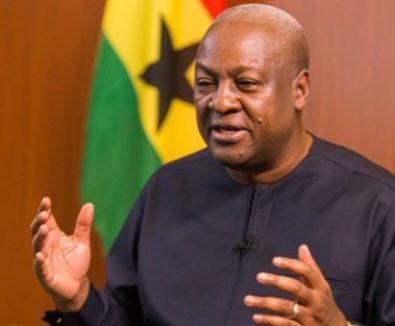
President John Dramani Mahama has used his first media engagement since beginning his second term to highlight what he described as a “national reset”
President John Dramani Mahama has used his first media engagement since beginning his second term to highlight what he described as a “national reset” that is transforming Ghana’s economy, education, health, and agriculture sectors.
The event, held on Wednesday evening, at the Jubilee House marked eight months since his January 7, 2025 inauguration and offered the president an opportunity to assess his administration’s progress and vision.
A Mandate for Change
Reflecting on his re-election, President Mahama recalled the December 7, 2024 polls, which he said gave him a “resounding mandate” to lead the country into a “new era of accountability and honest governance.”
According to him, the vote was more than a political victory — it was a national call for leadership that delivers results.
“I knew we had inherited a nation that was tired of excuses and weighed down by hardship,” Mahama said, emphasizing that his administration was determined to move away from “business as usual” politics.
Economic Management and Stability
The president outlined several economic measures taken within the past eight months.
Among them, the removal of nuisance taxes, stabilization of the exchange rate, and reductions in the cost of doing business.
He claimed inflation had dropped to a four-year low, signaling renewed macroeconomic stability.
In addition, he pointed to interventions in the power sector that averted what he called a “doomsday crisis” and pledged that Ghana’s economy was on the path to revival.
Education at the Centre of Reform
Mahama devoted much of his address to education, describing it as the cornerstone of national transformation.
He announced that the “No-Fee Stress Policy,” launched three months ago, had already refunded fees to 120,000 first-year students in public tertiary institutions.
This initiative, he explained, is linked to a broader “Student Loan Plus Policy” to ensure financial access for students from low-income households.
He further confirmed the continuation of the Free Senior High School (SHS) policy, which he insisted had not only been maintained but strengthened with the highest-ever budget allocation of GH¢3.5 billion.
To improve quality, he revealed a decentralized feeding policy for schools, alongside GH¢564.6 million allocated for basic education textbooks.
The president also announced the roll-out of the Free Tertiary Education Policy for Persons with Disabilities and the distribution of over six million sanitary pads to schoolgirls to fight period poverty.
Strengthening Health and Social Protection
On healthcare, Mahama said his administration had increased the national health budget by 13.4% — from GH¢15.6 billion to GH¢17.8 billion.
He touted the release of funds to the National Health Insurance Scheme (NHIS), the steady flow of medical supplies, and the launch of the Ghana Medical Trust Fund to help citizens manage chronic diseases.
“The governing board of the Ghana Medical Trust Fund has been approved and will soon be inaugurated,” he disclosed.
Agricultural Growth and Digital Economy Push
The president also spoke of renewed efforts to revitalize agriculture, particularly with youth-focused programs, irrigation expansion, and the Land and Farm Bank Project to make Ghana food-secure and export-competitive.
In technology, he highlighted investments through the “One Million Codex Program,” describing it as part of his vision to build a digital economy and foster innovation.
Investing in Research and Knowledge
Mahama stressed the importance of intellectual sovereignty, announcing the creation of the Ghana National Research Fund with an initial GH¢50 million allocation to support research in science, technology, humanities, and the arts.
For decades, he argued, Ghanaian academics had relied on foreign funding, which left the country without ownership of its own research outcomes.
To reinforce this commitment, he revealed that five PhD candidates in every public university would receive full government scholarships annually.

COMMENTS