
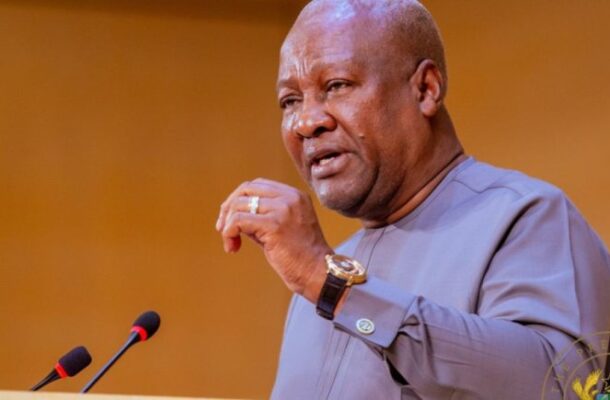
President John Dramani Mahama has ordered an investigation into allegations that some government appointees may have paid thousands of cedis to receiv
President John Dramani Mahama has ordered an investigation into allegations that some government appointees may have paid thousands of cedis to receive honours at a private awards ceremony, a controversy that has sparked national debate over ethics, accountability and the integrity of public office.
The development follows mounting public criticism and the submission of a formal petition to the Presidency demanding a thorough probe into claims that certain ministers, chief executives and government officials allegedly paid between GH¢25,000 and GH¢50,000 to secure recognition at the 6th Ghana Ministers of State Excellence Awards held on June 6, 2026.
The allegations have raised serious questions about the credibility of private awards schemes and whether public officials should participate in ceremonies where honours are allegedly linked to financial contributions.
Speaking on Asaase Radio’s “The Forum” programme on Saturday, June 13, National Democratic Congress (NDC) communications team member and lawyer Ibrahim Ali confirmed that President Mahama had directed that the allegations be investigated.
According to him, the President would not act solely on social media commentary or unverified allegations but would instead await the outcome of an independent assessment before considering any disciplinary action.
“The President cannot rely on mere allegations and social media speculation to take action,” Ali stated.
He explained that individuals had been tasked to examine the matter and determine whether there was any basis for sanctions against officials implicated in the controversy.
Ali emphasized that, as of now, no official findings had established that any government appointee had engaged in wrongdoing or made payments in exchange for awards.
The controversy comes only days after President Mahama announced a ban on private awards schemes involving government appointees, citing concerns about public accountability, ethics and the need to protect the integrity of public office.
The directive was widely interpreted as an effort to restore confidence in public service and prevent situations that could create perceptions of impropriety among state officials.
However, the issue escalated further after a petition dated June 8 was submitted to the Chief of Staff at the Office of the President demanding a formal investigation into the awards ceremony.
The petition was jointly filed by Kwaku D.A. Takyi and Kamaldeen Ibrahim, who argued that the allegations, if proven, could severely damage public trust in government institutions and public office holders.
The petition specifically referenced claims allegedly attributed to the Director-General of the State Interests and Governance Authority (SIGA), Dr. Michael Kpessa-Whyte, who reportedly disclosed that he declined participation in the awards event after organisers allegedly requested payments for each award recipient.
The petitioners argued that such allegations, if substantiated, would represent a serious breach of ethical standards expected of public officials.
They therefore called on the Presidency to commission an independent investigation, make the findings public, sanction any officials found culpable and establish clear guidelines governing the participation of government appointees in privately organized awards schemes.
The petition names several prominent government officials who reportedly received honours at the event.
Among those mentioned are Finance Minister Cassiel Ato Forson, Lands and Natural Resources Minister Emmanuel Armah-Kofi Buah, Greater Accra Regional Minister Linda Akweley Ocloo, Eastern Regional Minister Rita Akosua Awatey, Deputy Transport Minister Dorcas Affo-Toffey, DVLA Chief Executive Julius Neequaye Kotey, Ghana Shippers Authority Chief Executive Yaw Gyampo and National Service Authority Director-General Ruth Seddoh.
The petition does not present evidence that the named officials personally made payments but calls for investigations to establish the facts surrounding the awards process.
The controversy has also generated strong reactions from legal and governance experts.
Private legal practitioner Kwesi Fokuo-Benyin has questioned whether existing ethical guidelines governing public officials are being adequately enforced.
Speaking on the same radio programme, he argued that the situation points to broader weaknesses in the implementation of the code of conduct established for government appointees.
According to him, the Presidency’s intervention appears to have come only after public outrage had intensified.
“The President had already instituted a code of conduct, and these actions clearly fall within its scope. Why was the whip not cracked earlier?” he asked.
Fokuo-Benyin further suggested that it was difficult to believe that senior officials within government were unaware of the awards event before it took place.
He described the subsequent directive from the Presidency as appearing reactive rather than preventive, arguing that stronger oversight mechanisms should have been activated before the controversy emerged.
The lawyer also rejected attempts by some commentators to compare the current situation with previous presidential honours programmes, insisting that state-sponsored awards differ fundamentally from private schemes where questions have been raised about payments and selection processes.
According to him, accountability for ministers and public officials ultimately rests with the Presidency because the President appoints them and sets the performance targets they are expected to achieve.
The controversy has reopened a broader national conversation about the growing number of private awards ceremonies in Ghana and the criteria used to select recipients.
In recent years, numerous private organisations have emerged to honour politicians, public servants, corporate leaders and institutions through various recognition schemes.
While supporters argue that such awards promote excellence and encourage public service, critics have repeatedly questioned the transparency of selection processes and whether some awards have become commercial enterprises rather than genuine recognition platforms.

COMMENTS