
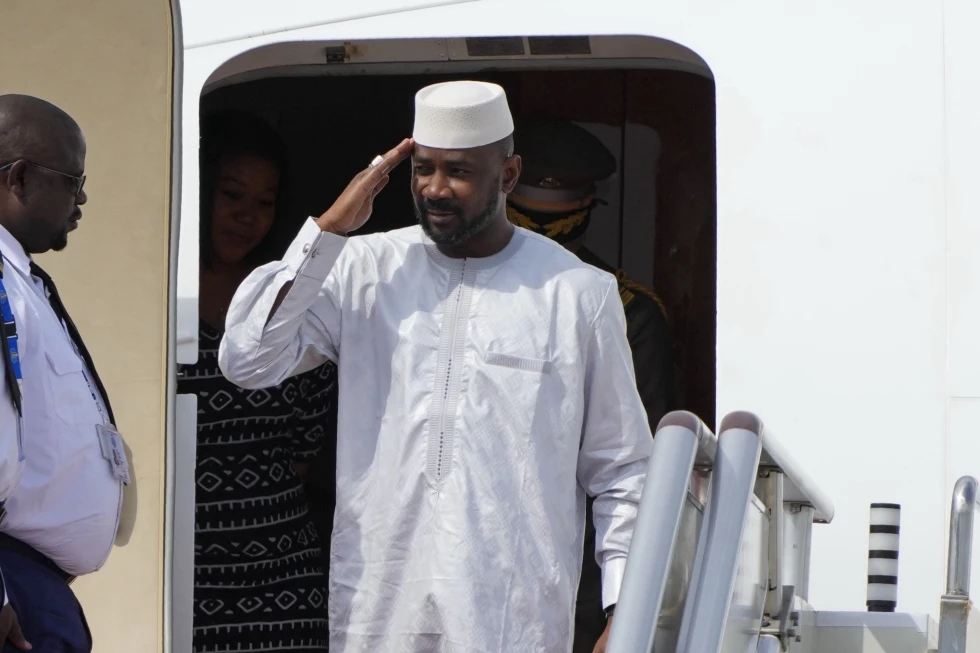
Mali's military authorities on Thursday granted the junta chief a five-year presidential mandate, renewable "as many times as necessary" and
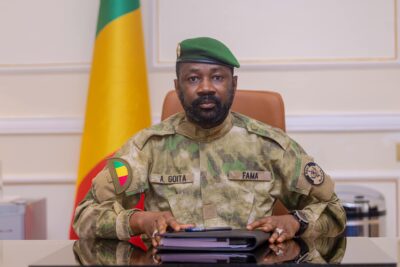
Mali’s military authorities on Thursday granted the junta chief a five-year presidential mandate, renewable “as many times as necessary” and without an election.
The move clears the way for General Assimi Goïta to lead the West African country until at least 2030, despite the military government’s initial pledge to return to civilian rule in March 2024.
The bill, adopted by the legislative body, now only needs approval by the junta leader himself who rose to power following back-to-back coups in 2020 and 2021.
It is the latest in a series of restrictions on freedoms by Mali’s military leadership to consolidate its power in the jihadist-hit Sahelian nation.
The bill was unanimously backed by the 131 members present in the National Transitional Council, an AFP journalist said.
The cabinet, the Council of Ministers, had already adopted the measure last month.
The transition is fixed at five years, renewable “as many times as necessary, until the pacification of the country, from the promulgation of this charter”, the bill, seen by AFP, states.
The transitional president, government and legislative members are eligible to stand in presidential and general elections, the text says.
“This is a major step forward in the rebuilding of Mali,” Malick Diaw, president of the National Transitional Council, told AFP after Thursday’s vote.
“The adoption of this text is in accordance with the popular will,” he said.
When Goïta took power, he insisted on Mali’s commitment to the fight against jihadist violence and initially pledged a return to civilian rule.
But the military ultimately reneged on its promise to cede power to elected civilians by their own deadline.
Repression of dissent
Earlier this year, a junta-led national consultation recommended the move proclaiming Goïta president without a vote for the five-year renewable term.
The same assembly – boycotted by most political groups – also recommended the dissolution of political parties and tougher rules for their creation.
Subsequently, the junta announced in May the dissolution of all political parties and organisations, as well as a ban on meetings.
The ongoing squeeze on Mali’s civic space comes against a backdrop of clamour by authorities for the country to unite behind the military.
Since 2012, Mali has been mired in violence carried out by jihadist groups affiliated with al Qaeda and the Islamic State (IS) group, as well as other criminal organisations.
Those attacks have only intensified in recent weeks.
The Malian army and its Russian mercenary allies from Africa Corps, tasked in particular with tracking down jihadists, are regularly accused of rights violations against civilians.
Mali and its junta-led neighbours Burkina Faso and Niger have teamed up to create their own confederation, the Alliance of Sahel States (AES), and have announced the creation of a joint 5,000-strong force for joint military operations.
In Niger and Burkina, political parties have also been dissolved and suspended.
Burkina’s junta leader Capitain Ibrahim Traoré, who seized power in a September 2022 coup, extended his transition at the helm of the country for an additional five years in May last year.
In Niger, General Abdourahamane Tiani overthrew democratically elected president Mohamed Bazoum in July 2023.
A national conference held in February strengthened the ruling junta by authorising Tiani to remain in power in Niger for the next five years.
Read more
‘Time to move on’: France faces gradual decline of influence in Africa
All three Sahelian countries have turned their backs on their shared former colonial master France in favour of stronger ties with Russia and other partners.
Source: FRANCE 24

COMMENTS