
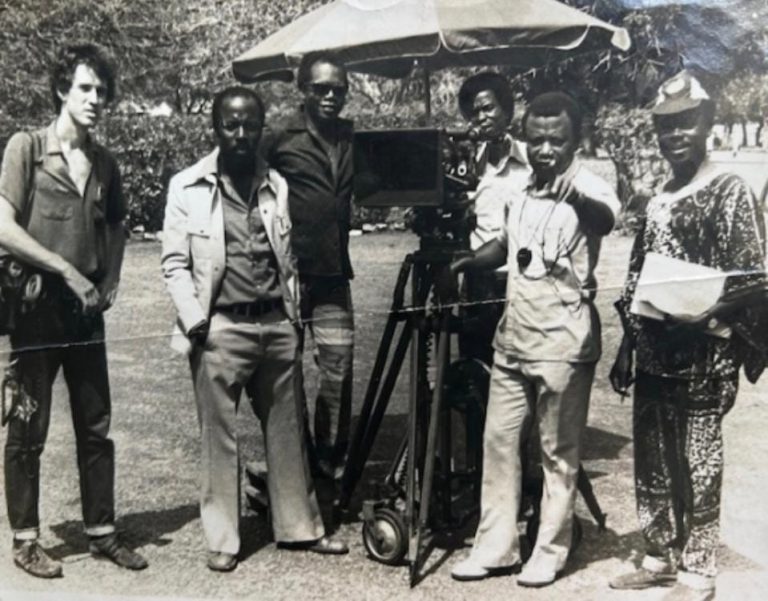
For over seven decades, the story of the transformation — from colonial rule to independence and beyond — has been immortalized through the lens of on
For over seven decades, the story of the transformation — from colonial rule to independence and beyond — has been immortalized through the lens of one man: Rev. Chris Tsui Hesse.
At 93, the legendary cinematographer stands as one of the most enduring visual historians, a man whose work defined the visual identity of a nation in motion.
A Journey Rooted in Passion and History
Rev. Hesse’s relationship with photography began in 1954 when he enrolled at the West African Film School, which would later evolve into the Ghana Film Industry Corporation (GFIC).
The name “Tsui,” meaning “heart” in Ga, is fitting — for Hesse’s heart has long been tied to the art and science of photography, a passion that has guided his every frame and reel.
Now the subject of a widely acclaimed documentary titled The Eyes of Ghana by Canadian filmmaker Ben Proudfoot, Rev. Hesse’s story was recently celebrated at the Toronto International Film Festival.
The documentary captures not just his technical mastery but also his unyielding spirit as a man who dedicated his life to telling the story through moving images.
The Cameraman Who Captured a Nation’s Rise
After Ghana gained independence in 1957, the new state invested heavily in film as a communication tool under President Kwame Nkrumah.
The GFIC became central to this vision, producing weekly newsreels that projected the progress to both domestic and international audiences.
It was during this era that Rev. Hesse emerged as one of the country’s most gifted cameramen.
His precision, speed, and artistry behind the camera soon caught Nkrumah’s eye. Impressed by Hesse’s ability to tell stories visually, the President personally requested that he be assigned to document most of his public events.
From Flagstaff House to the remotest corners of Ghana, Rev. Hesse’s lens captured the energy of a new nation in formation.
He accompanied Nkrumah on numerous international assignments, including the President’s fateful trip to Hanoi in 1966 — where Hesse was with him when the coup that overthrew Ghana’s first leader took place.
A Visionary in Ghanaian Cinema
Beyond political newsreels, Rev. Hesse expanded his artistry into feature films and documentaries.
His meticulous eye for lighting, composition, and camera movement helped shape the visual storytelling of some of the most iconic productions.
He worked on notable Ghanaian classics such as Ato Yanney’s His Majesty’s Sergeant and Kwaw Ansah’s Love Brewed in the African Pot, Heritage Africa, and Harvest at 17.
His ability to translate human emotion and cultural nuance onto film established him as a master cinematographer — one whose legacy extends beyond individual projects to the very foundation of the film industry.
Writer and director Ernest Kofi Abbeyquaye, who collaborated with Hesse at GFIC, described him as “a man with a real photographer’s eye, who could turn the ordinary into the extraordinary.”
Fighting for Ghana’s Film Heritage
While Rev. Hesse’s creative achievements are legendary, his lifelong advocacy for preserving the film archives is equally important.
In the absence of a color laboratory in Ghana, the GFIC sent all its celluloid films to London for processing and printing.
Over time, thousands of reels documenting the post-independence history accumulated overseas — stored under costly conditions that threatened their survival.
Determined to protect this national treasure, Rev. Hesse spent years lobbying successive governments to retrieve and safeguard the archival materials.
His commitment was so personal that, on several occasions, he reportedly urged his children to help pay off outstanding storage fees to prevent the films from being destroyed.
George Bosompem, Communications Director of the Ghana Academy of Film and Television Arts (GAFTA), hailed him as “a crusader for the preservation of the cinematic history,” noting that ongoing efforts are being made to secure and digitize the films.
Building a Legacy of Excellence
Rev. Hesse is one of the founding members of GAFTA — alongside industry pioneers such as Kwaw Ansah, King Ampaw, Martin Loh, Nana Adjoa Awindor, and Ernest Abbeyquaye.
The organization has played a critical role in promoting excellence and professionalism in the motion picture sector.
Through partnerships with international filmmakers like Ben Proudfoot, GAFTA continues to highlight the contributions of figures like Hesse, ensuring that younger generations understand the foundation upon which Ghanaian cinema stands.
A Heart That Never Stops Beating for Film
The Eyes of Ghana is scheduled for its Ghanaian premiere in December this year, a moment expected to serve both as a historical reflection and a national tribute.
For those unfamiliar with Rev. Hesse, the documentary offers an intimate introduction to a man whose camera captured the heartbeat of Ghana.

COMMENTS