

The National Security Coordinator, COP Osman Abdul-Razak, has described the country’s information space as a critical component of national security,
The National Security Coordinator, COP Osman Abdul-Razak, has described the country’s information space as a critical component of national security, arguing that responsible journalism is essential to protecting democracy and preventing threats before they escalate.
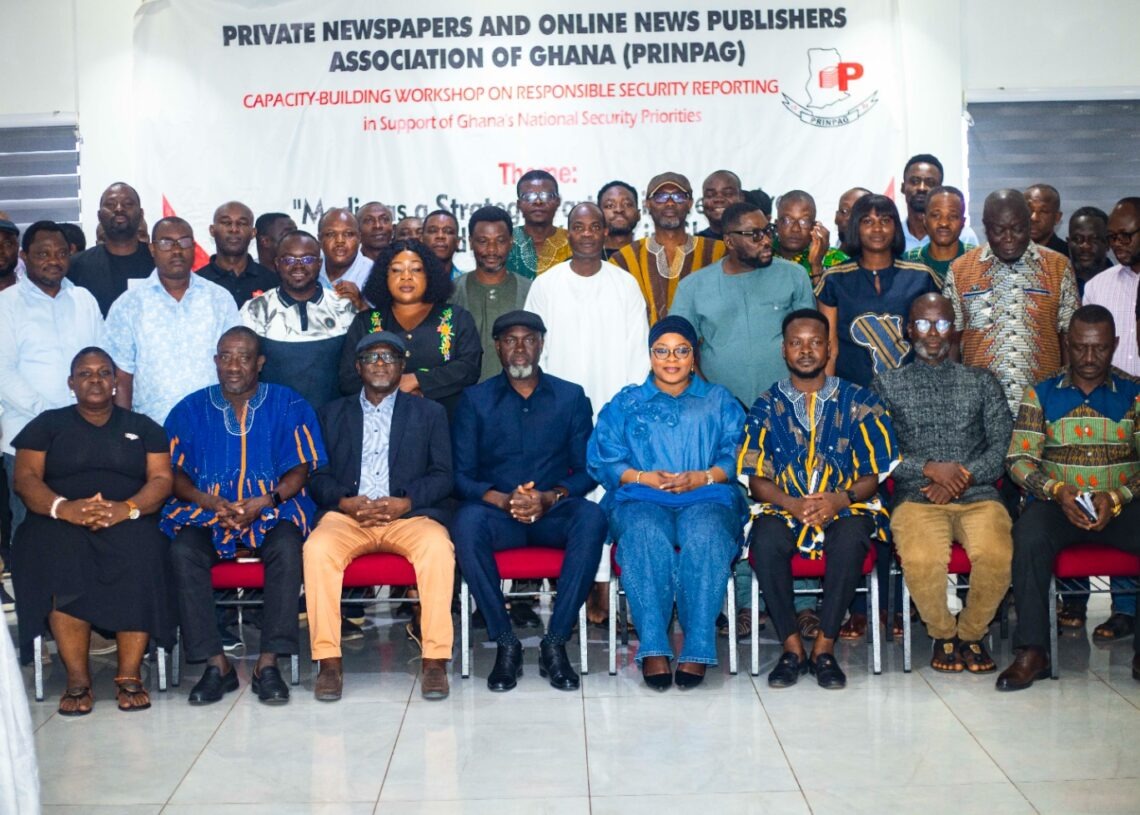
Speaking at a capacity-building workshop on responsive national security reporting organised for members of the Private Newspapers and Online News Publishers Association of Ghana (PRINPAG) in Accra, COP Abdul-Razak said Ghana’s securit perimeter extends beyond its physical borders, territorial waters and strategic installations to include the information environment.
He therefore highlighted the need for partnership between the media and the national security to tackle all forms of crime. He said the media could play a powerful preventive role by exposing corruption, holding public officials accountable and providing credible information, particularly during periods of heightened tension.
“When the press exposes corruption, it protects the public purse more than any prosecution,” he said, adding that responsible journalism could also provide a lawful avenue for public frustrations and help reduce the conditions that encourage violence, extremist recruitment and propaganda.
COP Abdul-Razak further stressed that truthful reporting during crises could prevent misinformation from worsening tensions and triggering conflict.
He noted that the relative democratic stability within a West African region that has experienced military takeovers was partly linked to the media’s willingness to act responsibly at critical moments.
“We have not come to teach. We have come to learn from each other,” he said.
PRINPAG President David Tamakloe, for his part, defended the continued relevance of professional journalism despite the rapid growth of social media.
He argued that the proliferation of digital platforms had made professional journalism even more important because trained journalists help counter misinformation, disinformation and unverified claims.
Tamakloe also called for stronger financial, regulatory and institutional support for Ghana’s private media sector, warning that a financially weakened media industry could struggle to maintain professional standards.
He urged government and state institutions to deepen partnerships with media organisations while respecting press freedom and editorial independence.
The two-day engagement brought together security officials, media executives, journalists and other stakeholders to explore practical ways of strengthening cooperation between the media and national security institutions without undermining democratic freedoms.
Deputy Presidential Spokesperson, Shamima Muslim called on the media to make timely and accurate reports their hallmark saying that whenever accurate information was delayed, it allows speculation and misinformation to take over.

COMMENTS