
The government led by the National Democratic Congress (NDC) has rebranded the Science, Technology, Engineering, and Mathematics (STEM) initiative int
The government led by the National Democratic Congress (NDC) has rebranded the Science, Technology, Engineering, and Mathematics (STEM) initiative introduced under former President Nana Addo Dankwa Akufo-Addo, now presenting it as BSTEM – Basic Science, Technology, Engineering, and Mathematics.
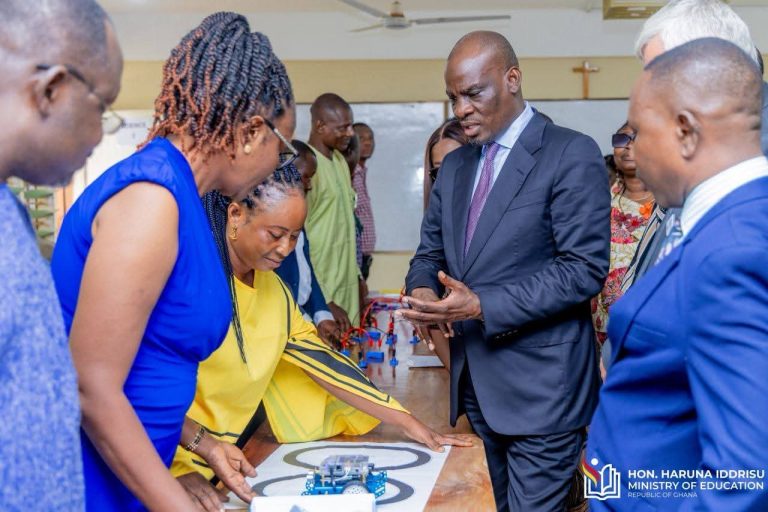
On Monday, August 18, 2025, the Minister for Education, Haruna Iddrisu, officially launched the BSTEM training programme in Sunyani.
According to the Minister, the initiative is aimed at strengthening the teaching and learning of STEM subjects from the basic school level.

New Label
The move has sparked debate over why the NDC administration chose to rebrand the STEM agenda instead of continuing under the same framework. Critics argue that successive governments in Ghana often prefer renaming existing programmes for political visibility rather than consolidating inherited policies.
The Akufo-Addo administration had invested heavily in STEM education between 2017 and 2024.
Key projects included the construction of the Accra STEM Academy, the establishment of 10 model STEM Senior High Schools across the country, and the development of 20 STEM centres.
Additionally, over 186 science laboratories were built nationwide to boost hands-on learning in robotics, biotechnology, and coding.
NDC Argument
Defending the rebrand, Haruna Iddrisu explained that the BSTEM initiative was not entirely new.
He traced its origins back to 2012–2016, under then Education Minister Prof. Jane Naana Opoku-Agyemang, when it was launched as the Basic Science and Mathematics Project.
According to him, the NDC government had always envisioned strengthening foundational science and math education at the basic level, which has now been expanded to include technology and engineering components.
He further explained that the rebranding to BSTEM is meant to emphasize the “basic” level of intervention, ensuring that children are introduced to critical STEM concepts early in their education journey.
“We are moving away from rote memorization and towards inquiry, problem-solving, and creativity,” he said.
Teachers
The Education Minister stressed that teachers remain central to this reform.
He noted that the success of BSTEM depends on adequately training teachers with 21st-century skills and equipping them with modern tools to deliver inquiry-based learning.
“No matter how well designed, a curriculum cannot succeed without teachers who have the knowledge, tools, and confidence to deliver,” Iddrisu stated, adding that the BSTEM training programme is specifically designed to enhance teacher capacity.
The NDC government argues that STEM—or BSTEM in its new form—is critical to the economic transformation.
Haruna Iddrisu highlighted that emerging fields such as artificial intelligence, biotechnology, renewable energy, and robotics all have roots in STEM.
By investing at the basic level, the government hopes to raise a generation of innovators and critical thinkers capable of addressing challenges in food security, healthcare, climate change, and sustainable energy.
“This project is not just a training exercise but a national investment,” Iddrisu said, noting that early exposure to scientific thinking could “ignite curiosity, creativity, and confidence” in pupils across the country.
Political Undertone
Despite the stated goals, the rebranding has been criticized by some education stakeholders and political commentators who see it as unnecessary duplication.
They question why the government could not simply continue with the STEM projects initiated under Akufo-Addo rather than renaming them for political credit.
Nonetheless, the government insists that the BSTEM programme represents both continuity and innovation.
The rebranding, it argues, reflects a more grassroots-focused approach to science and technology education.
For now, BSTEM has become the new face of Ghana’s education policy under the NDC, reigniting debates about the politics of policy continuity in the country.

COMMENTS