
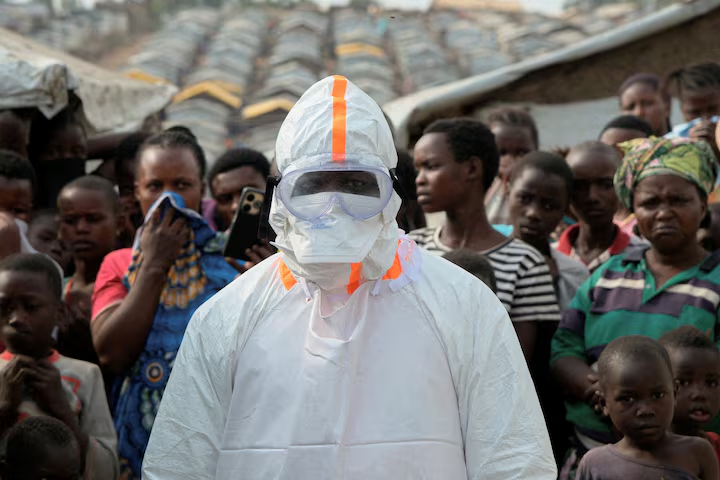
The Democratic Republic of Congo's rapidly spreading Ebola outbreak actually began in January, or possibly even earlier, in the eastern Ituri province
The Democratic Republic of Congo’s rapidly spreading Ebola outbreak actually began in January, or possibly even earlier, in the eastern Ituri province, months before authorities officially declared it, according to a report published in the journal Science.
The findings, based on interviews with 97 people, trace the outbreak’s origins to the outskirts of Mongbwalu, a mining town, and identify more than 500 suspected cases between mid-January and May 15, the date the outbreak was formally announced.
Experts had previously told Reuters that infections were likely circulating for weeks or even months before Congo’s health authorities and Africa’s top public health agency declared the country’s 17th Ebola outbreak.
The unpublished analysis paints a picture of a community gripped by fear and death well before the outbreak was recognised, families wiped out under mysterious circumstances, a local cemetery overwhelmed by bodies, and taxi drivers refusing to enter certain neighbourhoods, all while the disease spread undetected by distant health officials in Kinshasa.
One documented transmission chain traced back to a 50-year-old woman, identified only as “A,” who died on January 25 after vomiting blood; her mother died six days later, and her husband fell ill but survived.
By the time the outbreak was declared in May, it had already grown into what researchers described as a widespread, sprawling epidemic,
According to Wikipedia’s tracking of the crisis, it had since become the fastest-growing Ebola outbreak on record by the end of July.

COMMENTS