
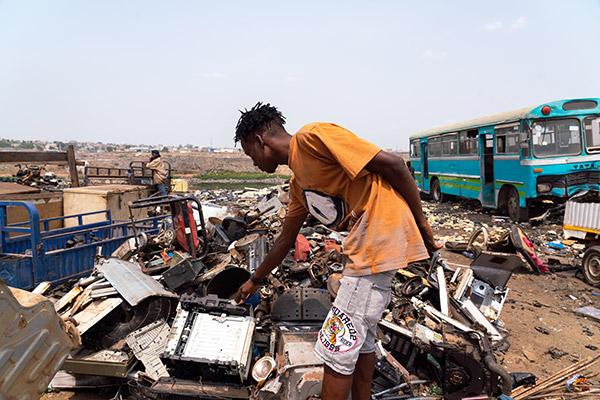
Ghana’s growing metal scrap trade is coming under renewed scrutiny over concerns that the largely informal nature of the industry is creating loophole
Ghana’s growing metal scrap trade is coming under renewed scrutiny over concerns that the largely informal nature of the industry is creating loopholes for the theft of public infrastructure, loss of revenue to local authorities and potential security vulnerabilities across communities.
A proposal submitted to the Minister for Local Government, Chieftaincy and Religious Affairs is calling for a coordinated national regulatory framework to govern metal scrap collectors, dealers, transporters, storage facilities, processing centres and exporters operating across the country.
The proposal, dated August 7, 2026, was submitted by Paul Coonley Boateng, Chief Executive Officer of Coonley Security Solutions Limited, and seeks national policy direction and the development of model by-laws that could be adopted by Metropolitan, Municipal and District Assemblies (MMDAs).
The document argues that scrap collection has become an important informal economic activity, providing livelihoods for many people while contributing to waste collection and recycling.
However, it maintains that the absence of a uniform regulatory system has increasingly created difficulties for local authorities in identifying operators, monitoring their activities and preventing the trade in suspected stolen metals.
From informal livelihood to governance concern
The proposal comes against a background in which scrap collection has expanded beyond individual communities and now involves movements of materials and operators across district boundaries.
According to the document, the fragmented nature of existing MMDA regulations means that an operator can move from one jurisdiction to another, making enforcement and traceability difficult. It argues that individual assemblies, acting separately, cannot adequately regulate an activity whose collection, transportation, trading and processing chains often cross municipal and district boundaries.
One of the central problems identified is the presence of unidentified and unregulated operators.
The proposal says many collectors work without formal registration or verifiable identification, while existing by-laws are either inadequate or inconsistently enforced.
The result, according to the submission, is an enforcement gap in which authorities may struggle to establish who is collecting scrap, where materials were obtained and where those materials are ultimately sold or processed.
Public infrastructure increasingly exposed
A major concern raised in the proposal is the alleged link between the informal scrap market and the theft or destruction of public infrastructure.
The document identifies manhole covers, electricity cables, streetlight poles, school gates, hospital equipment, telecommunications installations and railway lines among infrastructure reportedly targeted for their metal components.
It cites an April 2025 joint operation involving the Ghana Police Service and National Security, during which suspected Electricity Company of Ghana (ECG) cables were retrieved from a scrap dealer’s site in Accra.
It also refers to enforcement action in January 2026 by the Greater Accra Regional Coordinating Council and the Accra Metropolitan Assembly, which resulted in the shutdown of NN Est Metal Company Ltd and BlancoMet Recycling over allegations involving the purchase of stolen ECG cables.
According to the proposal, intelligence gathered during the operation indicated that stolen streetlight cables and other electrical materials were being traded through scrap dealers before being channelled into recycling facilities for copper extraction.
The document argues that the consequences extend beyond the immediate cost of replacing stolen materials. Damage to electricity networks, telecommunications infrastructure, transportation systems and other public assets can interrupt essential services and impose additional costs on government and communities.
Security concerns extend beyond stolen cables
The proposal also places the scrap sector within a broader national security discussion.
It acknowledges that comprehensive national datasets directly linking scrap collectors to major violent crimes are limited. However, it argues that documented cases involving stolen infrastructure, together with concerns raised by security institutions and commentators, warrant preventive regulation.
The submission references concerns raised by the Ghana Police Service, ECG and GRIDCo over theft of electricity cables and other critical infrastructure, noting that informal scrap markets can provide an outlet through which stolen materials enter the legitimate recycling chain.
It also cites observations attributed to the Africa Centre for Security and Intelligence Studies (ACSIS) concerning the mobile and informal nature of scrap collection.
The proposal says such movements could potentially provide opportunities for reconnaissance around residential areas, commercial facilities, places of worship and public institutions.
Importantly, however, the document itself acknowledges that direct causal links between scrap collection and serious crimes such as armed robbery, kidnapping, drug trafficking, rape or serial killings have not been conclusively established in the absence of consolidated national data.
The proposal therefore frames the issue primarily as one of risk mitigation and preventive regulation, rather than claiming that scrap collectors as a group are responsible for serious crimes.
Communities report growing suspicion
At the community level, the proposal says unregulated scrap activities have also contributed to perceptions of insecurity.
According to the document, ACSIS reports from 20 district assemblies in 2025 recorded increased complaints from residents about suspicious activities, particularly during early-morning and late-night periods.
The proposal says some confrontations have occurred between residents and suspected scrap collectors, with the document specifically noting that some of those suspected collectors were foreign nationals.
It warns that such confrontations could contribute to vigilantism, weaken public confidence in law enforcement and increase tensions between communities and people engaged in legitimate economic activity.
The proposed response is therefore not simply increased policing, but the introduction of identification, traceability and accountability mechanisms that would enable residents and authorities to distinguish legitimate operators from unregistered individuals.
Assemblies also losing potential revenue
Beyond security and infrastructure protection, the proposal identifies revenue mobilisation as another major concern.
It argues that much of the scrap sector operates outside the formal tax and regulatory framework, with operators functioning without appropriate licences and therefore avoiding fees, levies and other charges that could contribute to the Internally Generated Funds of MMDAs.
The document contends that formalising the sector could allow assemblies to improve monitoring while generating additional revenue.
It also argues that a regulated scrap industry could create opportunities for responsible recycling, environmental management, decent employment and investment, rather than eliminating the sector altogether.

COMMENTS