
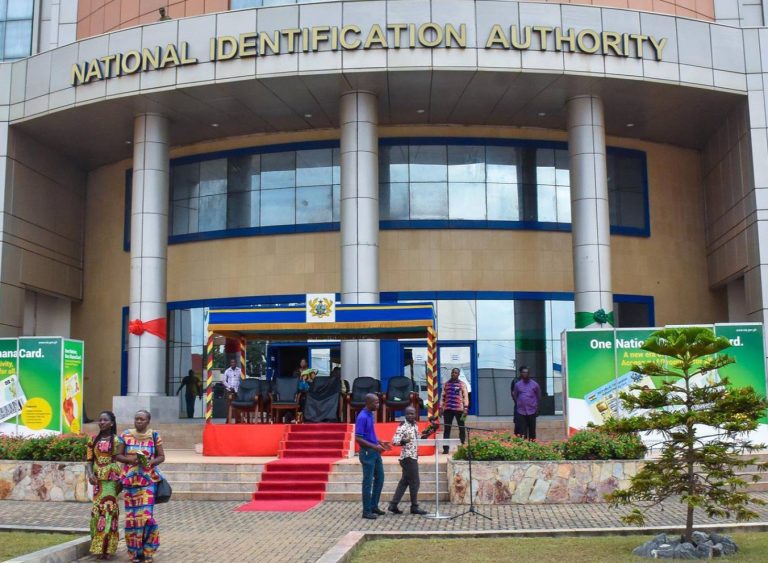
The National Identification Authority (NIA) has been thrust into a heated internal confrontation as its Divisional Workers’ Union and management clash
The National Identification Authority (NIA) has been thrust into a heated internal confrontation as its Divisional Workers’ Union and management clash over proposed amendments to the NIA Act and the Security and Intelligence Agencies Act.
The controversy has sparked widespread anxiety among staff, who fear the new laws could strip them of their labour rights and job security under the guise of aligning the Authority with national security structures.
The Divisional Union of the NIA, in a strongly worded statement signed by its Chairman, Francis Bangfudeme Nyuzaghl, and Secretary, Adu Kyeremeh Kwabena, accused policymakers of attempting to “sneak in” legal provisions that could undermine staff protections while misleading the public into believing that the Authority is being upgraded into a security institution.
Background to the Controversy
The current standoff traces back to recent proposals from the Ministry of the Interior responsible for the NIA to amend sections of the NIA Act and the Security and Intelligence Agencies Act.
The ministry’s stated goal is to formally integrate the NIA into the country’s security architecture due to its management of sensitive biometric and demographic data — an essential pillar of the national security.
However, the workers’ union claims that the draft law contains provisions that go far beyond the stated purpose.
They argue that certain clauses, if passed, would erode fundamental labour rights protected under the Labour Act, 2003 (Act 651), and could potentially pave the way for arbitrary dismissals.
Union Raises Alarm Over Job Security
According to the Union, one of the most alarming aspects of the draft amendment is a “re-appointment clause” that would require all NIA employees to be reappointed at the discretion of the Sector Minister once the law takes effect.
The Union warned that such a provision “overthrows the basic protections of the Labour Act,” effectively subjecting the entire workforce to political control and potential victimisation.
“This is a dangerous clause that opens the door to arbitrary dismissals and instability,” the statement read.
Another contentious proposal is what the Union describes as a “de-unionization clause,” which would prohibit NIA staff from forming or joining trade unions.
The Union condemned this as “unjustified and unlawful,” emphasizing that the NIA is not among the institutions exempt from unionization under Ghanaian law — such as the Armed Forces, Police, Prisons, and other officially listed intelligence agencies.
“The attempt to remove our right to collective bargaining is unconstitutional and a direct attack on workers’ freedoms,” the statement added.
Union Rejects ‘Backdoor Securitization’ Without Benefits
While the Union said it is not opposed to the idea of properly classifying the NIA as part of the national security framework, it stressed that such a transition must be transparent, lawful, and accompanied by improved conditions of service commensurate with security agency standards.
“Our position is clear — we support legitimate securitization that enhances staff welfare,” the Union stated.
“What we oppose is a backdoor process that strips our members of rights without extending the corresponding benefits of being a security agency.”
The Union revealed that it had requested copies of the proposed Legislative Instrument (L.I.) outlining new conditions of service but had not received any feedback from management.
They further accused the proposed law of giving excessive power to the Sector Minister, particularly over recruitment, promotions, and disciplinary actions, which they say undermines the independence of the Public Services Commission.
Management Denies Allegations, Calls for Calm
In a detailed response issued on October 26, 2025, the management of the NIA, led by Executive Secretary Mr. Wisdom Kwaku Deku, dismissed the Union’s claims as “misinformation” and “unfortunate.”
According to the statement signed by Williams Ampomah E. Darlas, Head of Corporate Affairs, the amendments are intended to strengthen the NIA’s alignment with national security structures, improve operational efficiency, and protect sensitive national data — not to threaten staff welfare.
“It is true that the Ministry has initiated processes to align the Authority’s operations with national security structures,” the statement read.
“However, this classification will not undermine staff welfare. Rather, it will enhance institutional security and safeguard employee concerns through structured mechanisms.”
On the controversial reappointment clause, management clarified that there will be no mass re-engagement or dismissal of staff.
Instead, the proposed amendments introduce background verification procedures consistent with national security standards to ensure integrity and trust in identity management operations.
The NIA also insisted that no law has been laid before Parliament yet and that the proposals remain under stakeholder consultation.
Management emphasized that it has already held “extensive engagements” with the NIA Division and its mother union, the Public Services Workers’ Union (PSWU) of the Trades Union Congress (TUC).
TUC’s Role and Presidential Involvement
The Union confirmed that the TUC had written to President Mahama expressing concern over the lack of consultation in the amendment process.
The President, in response, directed the Sector Minister to engage the TUC and report back — a move the Union described as standard democratic practice rather than a disciplinary complaint.
Despite this clarification, management described the Union’s publication as “regrettable and made in bad faith,” warning that such public confrontation could undermine collaboration and mutual respect within the institution.
Union Calls for Vigilance and Unity
In its concluding remarks, the NIA Divisional Union urged all staff to remain calm but alert to any legislative moves that could affect their livelihoods.
“This is not about resisting national security alignment,” the statement emphasized. “It is about defending our constitutional and labour rights from being eroded under the guise of reform.”
Both parties, however, agree on one point — the need for a stronger, more efficient NIA capable of protecting the national identity infrastructure.
The challenge now lies in balancing that goal with the protection of workers’ rights, transparency, and adherence to due process.

COMMENTS