
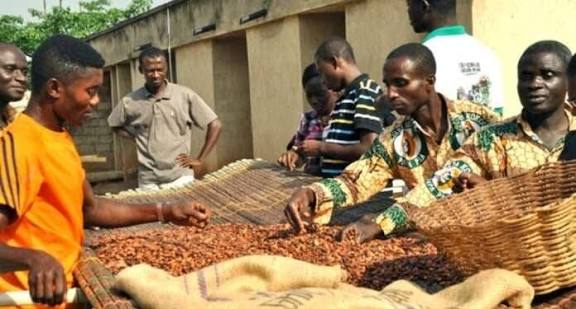
Despite record-breaking cocoa prices on the global market, millions of smallholder farmers in West Africa continue to live in extreme poverty, accordi
Despite record-breaking cocoa prices on the global market, millions of smallholder farmers in West Africa continue to live in extreme poverty, according to the newly released 2025 Cocoa Barometer.
The report paints a sobering picture of systemic inequality, climate vulnerability, and policy failures that have kept the region’s cocoa producers trapped in hardship, even as global demand and profits surge.
West African Farmers Left Behind Amid Cocoa Boom
Ghana and Côte d’Ivoire together produce more than 60 percent of the world’s cocoa, making them central to global supply and price determination.
Nigeria is also fast emerging as a key producer, projected to harvest about 350,000 tonnes in the 2024/2025 season.
Yet, according to the Barometer, farmers in these countries are reaping little benefit from record international prices that have reached historic highs this year.
The report attributes this paradox to forward-selling mechanisms that delay local price adjustments, coupled with declining yields caused by aging cocoa trees, rampant crop diseases, and unpredictable rainfall patterns linked to climate change.
Rooted in Poverty: The Structural Crisis
The Cocoa Barometer identifies farmer poverty as the central issue underpinning nearly all other challenges in the cocoa sector—from deforestation and child labour to gender inequality and exploitative pricing systems.
Despite widespread recognition of the problem, new human rights and environmental due diligence laws in Europe, which could have transformed the sector, are facing political resistance that threatens to undo years of advocacy.
It is estimated that 1.5 million children still engage in hazardous work on cocoa farms across Ghana and Côte d’Ivoire.
Meanwhile, women—who perform a majority of the farm labour—remain largely excluded from decision-making and profit-sharing structures.
The report also draws attention to tenant farmers and hired labourers, often overlooked in public debates, yet among the most vulnerable and underpaid actors in the cocoa value chain.
Environmental And Market Risks
High global cocoa prices are driving a surge in production and expansion into new forested areas, sparking fresh waves of deforestation across West Africa.
The Barometer warns that if this expansion continues unchecked, it could lead to overproduction and another market collapse similar to what occurred in 2016 when prices plummeted following a supply glut.
Climate change compounds the crisis, with erratic rainfall and rising temperatures threatening to make cocoa cultivation unviable in several traditional growing regions within the next decade.
Governance Gaps And Lack of Transparency
The report is equally critical of weak governance and lack of transparency in cocoa-producing countries.
It notes that supply management systems remain largely absent, leaving farmers vulnerable to market volatility.
Furthermore, the opacity surrounding cocoa sales and farmgate pricing—the amount farmers actually receive—continues to shield industry actors from accountability.
While Ghana and Côte d’Ivoire have made efforts to introduce a Living Income Differential (LID) to improve farmers’ incomes, the Barometer finds that the initiative has not significantly improved livelihoods due to poor enforcement and industry pushback.
A Call for Systemic Change
Despite the grim findings, the 2025 Cocoa Barometer remains cautiously optimistic about the potential for reform.
It calls for stronger collaboration among farmers, governments, chocolate companies, and civil society organizations to achieve systemic change.
Key recommendations include:
Fair pay and a living income for all cocoa farmers.
A global moratorium on cocoa-related deforestation.
Gender-inclusive decision-making in farming communities.
Full transparency and accountability throughout the supply chain.
The Cocoa Barometer Initiative
The Cocoa Barometer is an independent sustainability review produced by a consortium of civil society organizations.
Since its inception, it has provided critical insights into trends, progress, and persistent challenges in the global cocoa industry.
The 2025 edition builds on decades of research, outlining both the achievements—such as growing awareness and regulatory progress—and the setbacks, including worsening climate threats and ongoing human rights abuses.
In summary, while cocoa prices are at an all-time high, the wealth generated from the multi-billion-dollar chocolate industry continues to bypass the very farmers who make it possible.
Unless governments, corporations, and consumers act collectively to address structural injustices, the report warns, West Africa’s cocoa story will remain one of exploitation beneath prosperity.

COMMENTS