
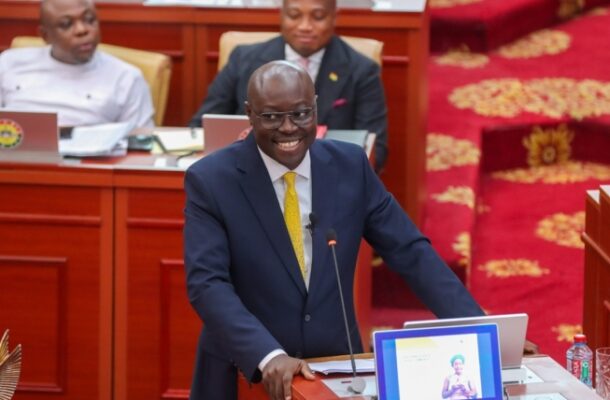
Minister for Finance, Ato Forson, has responded to criticisms from opposition lawmakers regarding Ghana’s 2026 budget, insisting that the government’s
Minister for Finance, Ato Forson, has responded to criticisms from opposition lawmakers regarding Ghana’s 2026 budget, insisting that the government’s growth projections and inflation management strategies are grounded in evidence and sound economic planning.
In a detailed statement, the Minister addressed claims by Kojo Oppong Nkrumah, Abena Osei-Asare, and Dr. Mohammed Amin Adam, who described the projected 4.8 percent economic growth in 2026 as “illogical” following a strong first-half performance in 2025.
Ato Forson rejected this characterization, emphasizing that the figures reflect a realistic and responsible approach to forecasting rather than political wishful thinking.
“Growth assumptions must be anchored in evidence, not bravado,” the Finance Minister said.
He further noted that the projections are credible because they are based on data-driven analysis rather than political narratives.
Addressing criticisms that the 2026 budget is “growthless” and “jobless,” Forson countered that the recent disinflation trends are a direct result of deliberate government interventions.
Data from the Ghana Statistical Service has identified food inflation as the primary source of price volatility, prompting targeted measures to stabilize the economy.
Key initiatives highlighted by the Minister include the expansion of the Feed Ghana inputs program and support for the vegetable value chain, irrigation projects covering over 10,000 hectares, and the deployment of more than 4,000 mechanized units through Farmer Service Centres.
Forson also pointed to broader infrastructure and market interventions, including the construction of 1,000 kilometers of agriculture-enclave roads to reduce transport costs and improve market access, as well as GH¢200 million allocated for buffer-stock operations.
Additional stabilisation measures span warehousing, aquaculture, and market infrastructure improvements.
“Mr. Speaker, this is what it means to let the data shape policy,” Forson concluded, underscoring that Ghana’s economic roadmap is grounded in practical strategies aimed at sustaining growth, creating jobs, and curbing inflation.

COMMENTS