
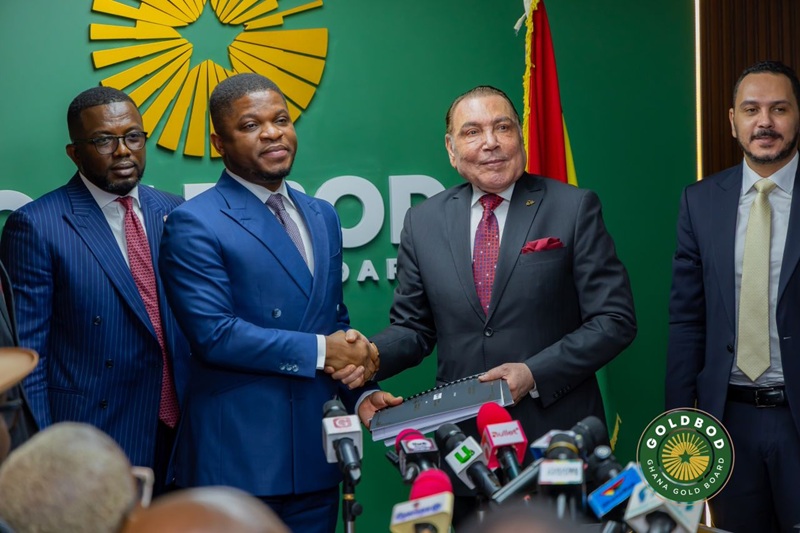
The Ghana Gold Board (GoldBod) has signed a landmark Memorandum of Understanding (MoU) with Gold Coast Refinery Limited to ensure that gold exploited
The Ghana Gold Board (GoldBod) has signed a landmark Memorandum of Understanding (MoU) with Gold Coast Refinery Limited to ensure that gold exploited in Ghana is refined locally before export, marking a major step towards value addition and industrial growth in the country’s gold sector.
The agreement was signed at the Ghana Gold Board’s head office by its Chief Executive Officer Sammy Gyamfi, and the Chief Executive Officer of Gold Coast Refinery Limited, Dr Said Deraz.

Under the agreement, up to one metric tonne of gold—equivalent to 1,000 kilograms—exported by the GoldBod every week will be refined locally at the Gold Coast Refinery.
The initiative is expected to begin on February 1, 2026, with plans to gradually scale up operations to achieve the total local refining of all gold exported from Ghana.
Speaking at the signing ceremony, Gyamfi noted that despite Ghana hosting the largest gold refinery in the sub-region, nearly 99.9 per cent of the country’s gold exports—both from small-scale and large-scale mining—are currently exported in raw form.
“This situation is unacceptable. We have the capacity here in Ghana, yet we continue to send our gold abroad for refining,” he said, adding that discussions with Gold Coast Refinery began with the full backing of the Board of the GoldBod.

He explained that the partnership followed a detailed technical assessment of the refinery’s operational readiness and capacity, which led to recommendations aimed at improving efficiency and service delivery to the Government of Ghana.
Sammy Gyamfi commended Gold Coast Refinery for its resilience, noting that although the refinery was commissioned in November 2016 and has faced several challenges, it has remained committed to its operations in Ghana.
A key highlight of the agreement is the involvement of Grand Refinery, the only London Bullion Market Association (LBMA)–accredited refinery in Africa, which has been brought on board by Gold Coast Refinery.
“The coming on board of Grand Refinery will help strengthen technical and management capacity and position Ghana to achieve an LBMA-accredited refinery locally,” Gyamfi stated.
He further emphasized that the partnership will promote responsible and sustainable gold refining in line with OECD and LBMA guidelines, ensuring that all gold refined is responsibly mined and sourced. To support this, the Ghana Gold Board plans to roll out a track-and-trace system to enhance transparency and verification across the gold value chain.
According to Gyamfi, the gold refined under the agreement will meet the highest international standards, with Gold Coast Refinery capable of delivering purity levels of up to 99.999 per cent. Each gold bar exported will carry a hallmark bearing the emblems of Gold Coast Refinery, the Ghana Gold Board, the Ghana Standards Authority, and the Bank of Ghana.

He also revealed that the Government of Ghana has been granted a 15 per cent free carried interest in Gold Coast Refinery, which will be held and represented by the Ghana Gold Board on behalf of the Republic.
Beyond refining gold purchased and owned by the Ghana Gold Board, the CEO disclosed plans to engage the Ghana Chamber of Mines to encourage large-scale mining companies to refine their gold locally rather than sending it to refineries in Europe and other foreign destinations.
Gyamfi outlined the economic benefits of the agreement, including retaining millions of dollars in refining charges that are currently paid to refineries in countries such as Dubai, India, Switzerland, and Hong Kong.
He said these funds would now remain within the banking system, boosting the local economy.
The agreement is also expected to create both direct and indirect jobs, with Gold Coast Refinery committing to operate 24 hours a day in line with government’s 24-hour economy policy.
The Chief Executive Officer of Gold Coast Refinery Limited, Dr. Said Deraz, described the renewed push toward local gold refining as a defining moment in the country’s journey toward economic independence and self-reliance.
Dr. Deraz said the world is rapidly changing and Africa is steadily rising, driven not only by its abundant natural resources but also by its immense human capital.
According to him, Ghana is at the forefront of this transformation, taking deliberate and practical steps to gain greater control over its natural resources and reduce dependence on external systems.
Dr. Deraz noted that the agreement aligns strongly with the vision of President John Dramani Mahama, as well as key national initiatives such as the 24-hour economy framework and the establishment of the Ghana Gold Board, all aimed at building a strong, confident, and self-reliant nation.
He revealed that the idea for the refinery was conceived during President Mahama’s first term in office, leading to the completion and commissioning of the Gold Coast Refinery in November 2016.

COMMENTS