

Scientists have reconstructed the face of one of the earliest known members of our species, giving the public its most detailed look yet at what H

Scientists have reconstructed the face of one of the earliest known members of our species, giving the public its most detailed look yet at what Homo sapiens may have looked like around 315,000 years ago.
The work, led by forensic facial reconstruction specialist Cicero Moraes and published in the journal Heritage, is based on a three-dimensional composite skull built mainly from a fossil known as Irhoud 1.
The fossils were found at Jebel Irhoud in western Morocco, where a skull was first uncovered in the 1960s during mineral extraction and was initially believed to be a Neanderthal.
A reappraisal in 2017 showed the remains belong to the earliest Homo sapiens on record, dating to about 315,000 years ago, well before humans left Africa.
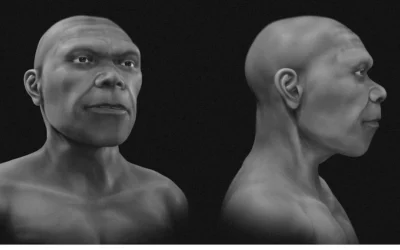
The result is a man with a broad face and a prominent brow, and the researchers say he looks strikingly familiar.
Moraes said that if he were dressed in modern clothes, he “would likely pass unnoticed” in a crowd. A closer look would reveal subtle differences, including a more robust brow ridge and greater facial projection, traits the team considered plausible for a North African of that era.
The team also estimated a brain volume of about 1,230 cubic centimetres, almost identical to the modern adult male average of 1,234, suggesting brain size has barely changed in 300,000 years.

The researchers stress that the reconstruction is an approximation, not a portrait of a specific individual.
Details such as hair, skin tone and facial hair cannot be read from bone, and a greyscale version without hair and beard was produced alongside the finished face.
They argue, however, that the skull limits how much the muscles and soft tissue could vary, so the man’s real face is unlikely to have looked very different.
The Jebel Irhoud finds also overturned the long-held view that modern humans first emerged in East Africa around 200,000 years ago, pointing instead to a species that spread across the African continent about 300,000 years ago.

COMMENTS