
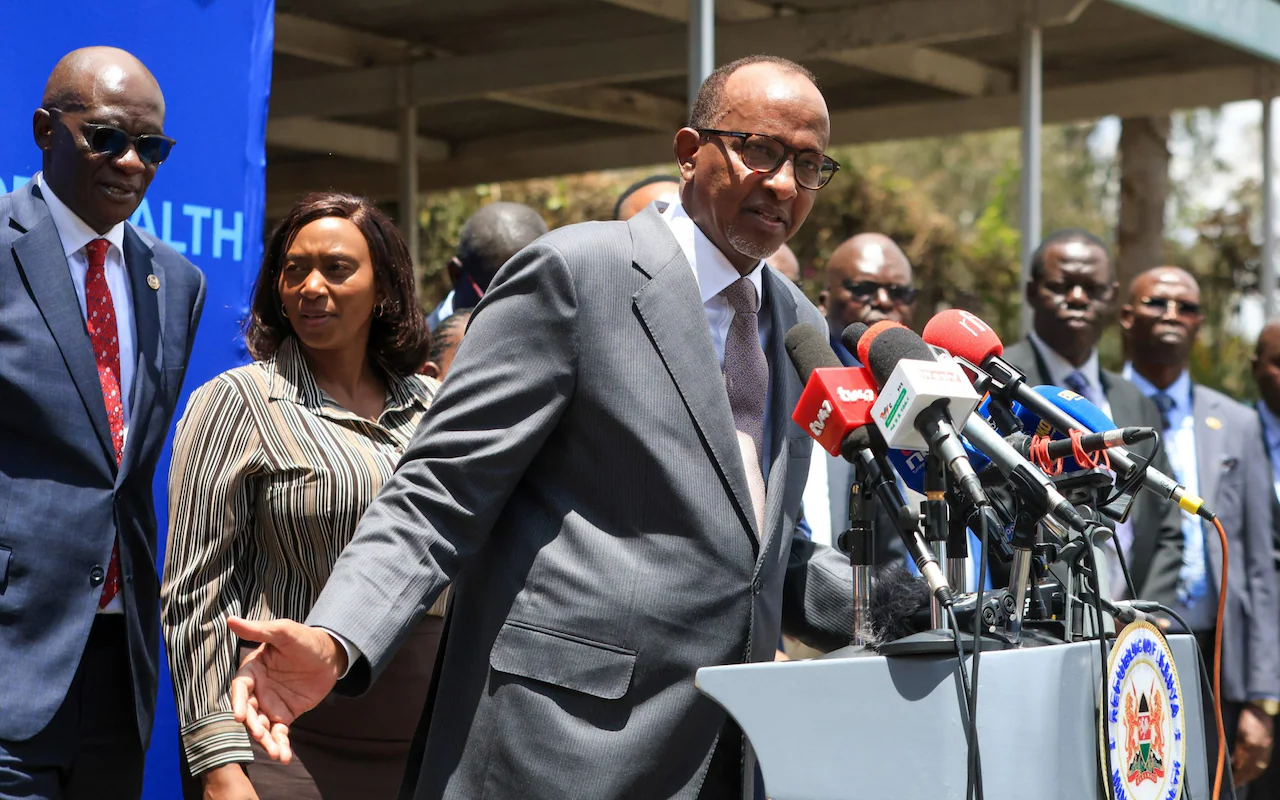
Kenya confirmed its first Ebola case on Tuesday after a Kenyan citizen who had travelled from the Democratic Republic of Congo died in Nairobi. Hea
Kenya confirmed its first Ebola case on Tuesday after a Kenyan citizen who had travelled from the Democratic Republic of Congo died in Nairobi.
Health Secretary Aden Duale told a news conference that the patient had lived in the DRC for seven years and had been ill for about a month before travelling by road to Kampala, Uganda, then flying to Nairobi on Saturday. After landing, he passed health screening and was taken by a relative to Nairobi Hospital, where he died late on Monday.
To stop any local spread, President William Ruto said at least eight of the victim’s relatives and 21 health workers have been quarantined, and he ordered an enhanced response.
The Africa CDC said it is sending a high-level team to Kenya and noted that the man spent a night in Uganda before the flight.
Uganda’s government spokesperson Alan Kasujja rejected the suggestion, saying “We don’t have Ebola here.” Uganda was declared Ebola-free in August after reporting 20 cases and two deaths earlier in the year.
Duale said the country is well prepared, having trained nearly 5,000 health workers across Kenya on prevention and management.
After the outbreak was declared in Congo, the United States built a 50-bed Ebola quarantine camp for US citizens on an Air Force base in central Kenya.
Nairobi’s Jomo Kenyatta International Airport is a major African transport hub that handles about nine million passengers a year.
The case is linked to an epidemic in eastern Congo that is the second largest on record, with more than 8,000 cases.
It is caused by the rare Bundibugyo strain, for which there is no proven vaccine or treatment, and the conflict in the affected region complicates the response.
The World Health Organisation has warned that the epidemic is far from over and could surpass the 2014-2016 West Africa outbreak, but it has advised against travel and trade restrictions on Kenya, the DRC and Uganda.

COMMENTS