
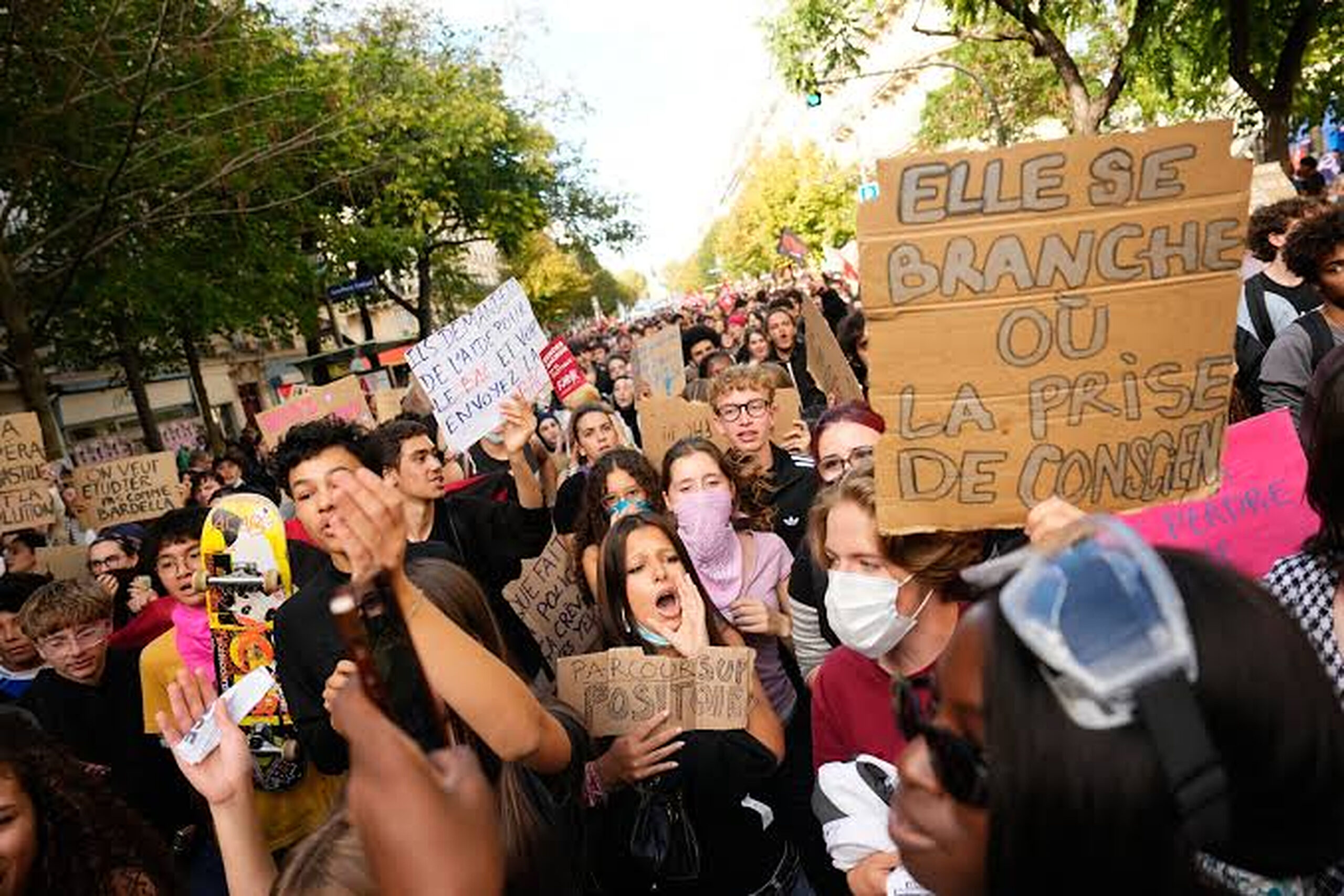
Tens of thousands of school pupils and trade unionists marched across France on Tuesday in the third nationwide day of action. A student-
Tens of thousands of school pupils and trade unionists marched across France on Tuesday in the third nationwide day of action.
A student-led movement over the state of public schools has now run for three weeks, with no sign of fading.
The protests began in high schools in the Paris region and have since reached cities including Strasbourg, Bordeaux, Nantes, Marseille and Lyon.
Students say absent teachers are not replaced, school buildings are run-down and sometimes rodent-infested, classes are overcrowded, and some schools lack enough tables and chairs, particularly in poorer areas.
They are calling for substitute teachers, more resources and better learning conditions.
Violence and arrests
The movement has grown more violent as it has spread. By 1 October, parts of the protests involved arson, attacks on staff and clashes with police, and the Interior Ministry said 1,949 people were arrested that day. University students joined the blockades the same day.
The ministry said around 6,100 people had been arrested since the protests began roughly two weeks ago. It also said the police inspectorate (IGPN) has opened ten investigations into police interventions during the mobilisation.
Daily life has been disrupted. On 5 October, between 400 and 500 schools across France were partially or totally closed.
The U.S. Embassy in France has warned of further closures and reduced services, including on public transport. Tuesday’s day of action drew student organisations, education unions and the national parents’ union.
A political headache for the government
The demonstrations followed a public-sector strike last week over budget plans, and they pose another challenge for President Emmanuel Macron’s cash-strapped government ahead of next year’s elections.
The government is under pressure to respond. On Tuesday, Prime Minister Sébastien Lecornu told ministers to address the students’ main demands and present initial proposals by the end of October.
Ending the unrest may not be straightforward. A teacher in Créteil likened the scenes to the 2006 movement against the first-employment contract (CPE), which ended when the government dropped the measure. The newspaper Politis noted a key difference: this time there is no single bill the government can withdraw.
What comes next
The pressure may not ease soon. Calls are growing for a “general mobilisation” on Saturday 17 October, with a “return” of the gilets jaunes (yellow vests) protests, and the movement is spreading on social media much as that earlier one did.
Unions are unlikely to call strikes on a Saturday, when most public-sector workers are off, though some unions and political organisations have backed the wider mobilisation.
For now, the protesters’ demands are concrete, and the grievances are widely shared, but the government has offered only a promise of proposals by the end of the month.
Whether that is enough to bring pupils back to class, or whether Saturday 17 October becomes the next flashpoint, will depend on how quickly Paris can show that it is listening.

COMMENTS