
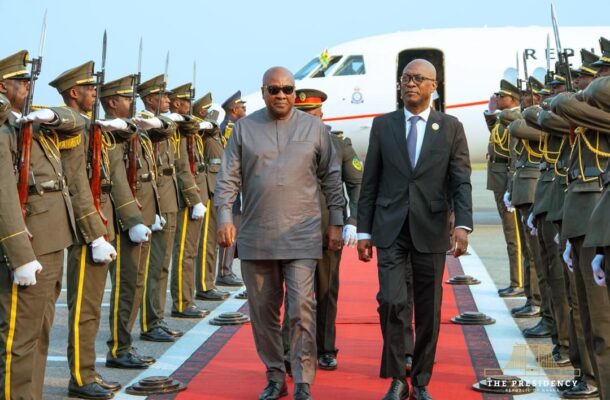
President John Dramani Mahama has arrived in Luanda, Angola, ahead of the 21st Extraordinary Session of the Assembly of Heads of State and Government
President John Dramani Mahama has arrived in Luanda, Angola, ahead of the 21st Extraordinary Session of the Assembly of Heads of State and Government of the African Union, where leaders will seek stronger continent-wide responses to conflict and insecurity.
The high-level meeting, scheduled for 30 August 2026, will focus on improving the African Union’s mechanisms for preventing and resolving conflicts. It will be chaired by Joao Manuel Goncalves Lourenco, President of Angola and the African Union’s Champion for Peace and Reconciliation in Africa.
President Mahama was welcomed at the airport by Victor Hugo Guilherme, Angola’s Minister for Planning, following his arrival in the capital.
The main item on the summit’s agenda is the consideration and adoption of a comprehensive Decision, Action Plan and Implementation Matrix on Conflict Prevention and Resolution for Africa.
The proposals are intended to provide a more coordinated and effective framework for addressing the continent’s peace and security challenges. African heads of state are expected to examine the existing systems designed to support stability, governance and conflict management, while agreeing on practical steps to strengthen their operation.
Particular attention will be given to improving coordination, responsiveness, implementation and financing within both the African Peace and Security Architecture (APSA) and the African Governance Architecture (AGA).
The meeting comes as several parts of Africa continue to face serious and increasingly complex security pressures. The agenda is expected to reflect conflicts and instability in Sudan, the Eastern DRC, the Sahel Region, the Horn of Africa and Mozambique.
The African Peace and Security Architecture provides the continental framework for preventing, managing and resolving conflicts, while the African Governance Architecture supports efforts to promote democratic governance and political stability.
African Union leaders will therefore be under pressure to move beyond existing commitments and agree on measures that can be implemented effectively across the continent. The session is expected to address not only the design of peace and security policies, but also the resources and coordination needed to put them into practice.
President Mahama and other participating heads of state are expected to work towards actionable strategies aimed at strengthening regional stability and improving Africa’s collective ability to build and sustain peace.
The summit’s conclusions will centre on the proposed Decision, Action Plan and Implementation Matrix, which are intended to guide future continental efforts on conflict prevention and resolution.
The gathering in Luanda represents a major opportunity for African leaders to assess the effectiveness of current peace and governance frameworks at a time when insecurity continues to affect multiple regions. It also provides a platform for them to agree on a shared approach to responding to the continent’s most pressing security challenges.

COMMENTS