
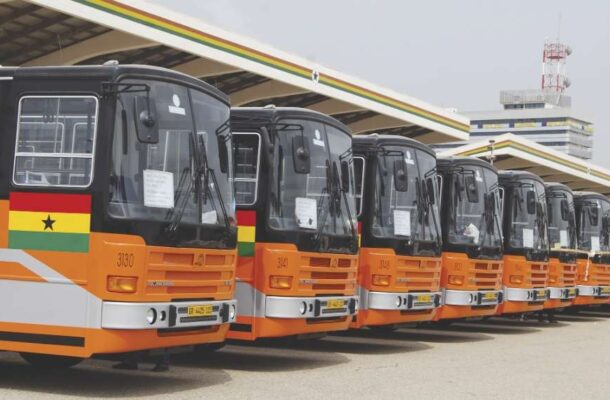
Managing Director of Metro Mass Transit Limited (MMTL), Kale Cezar, has disclosed that a container loaded with vital spare parts supplied by Dutch bus
Managing Director of Metro Mass Transit Limited (MMTL), Kale Cezar, has disclosed that a container loaded with vital spare parts supplied by Dutch bus manufacturer VDL has been left uncleared at the port for more than two years — worsening the operational and financial struggles of the state-owned transport company.
In an interview with the Daily Graphic, Mr Cezar said the shipment was brought in under the previous management but was never processed for clearance, resulting in mounting port charges and delays in repairing and deploying buses desperately needed on Ghana’s roads.
“That container full of steppers was supplied by VDL, but our predecessors brought it in and left it there,” he revealed.
Since assuming office, management has been working with institutions such as the Ghana Revenue Authority (GRA) to unravel why the consignment remained stuck for so long and what was required to secure its release.
After months of engagement and administrative processes, Mr Cezar said the company is finally close to clearing the container.
He appealed for tax and VAT waivers on Metro Mass imports, noting that such relief would significantly ease the company’s operational burden.
Recent transport disruptions in Accra and Kumasi have renewed public focus on Metro Mass, which has struggled to operate at full capacity due to aging buses and logistical setbacks.
Fewer Buses, Higher Revenue
Despite a reduced fleet, Mr Cezar revealed that the company’s finances have improved dramatically.
While previous management operated over 185 buses and generated between GH¢8.5 million and GH¢9 million monthly, Metro Mass now runs about 120 to 130 buses but raises more than GH¢15 million each month.
He attributed the turnaround to the near-total rollout of electronic ticketing, which has drastically cut revenue leakages.
“Before, only about 40 to 50 per cent of operations used the IT ticketing system. Now we are almost at 100 per cent,” he explained.
Much of the increased revenue is currently being used to clear inherited debts, but the company is now able to pay salaries, pensions, and other obligations on time.
Clearing Debts and Improving Worker Welfare
Mr Cezar said he took over a company weighed down by massive debts, unpaid taxes, fuel arrears, court judgments, and poor staff welfare.
Some frontline workers were earning as little as GH¢770 a month.
Management has since implemented a 20 per cent salary increase and raised the minimum wage to GH¢1,300, while restoring regular salary payments by the third week of every month.
Ambitious Expansion Plans
Looking ahead, the Metro Mass MD outlined bold plans to transform the company into a modern public transport giant within two years.
He aims to expand the fleet to at least 2,000 buses and establish a fully functional cargo transport division to serve institutions and businesses.
“People say it’s ambitious, but when you consider the routes we serve and the demand, that’s the scale we need,” he said.
Mr Cezar added that government is engaging investors to retool Metro Mass as part of a broader vision for reliable, affordable, and environmentally friendly public transport.
He stressed that an efficient transport system is central to supporting the government’s 24-hour economy agenda.
“No economy can thrive without an effective public transport network. If we want a 24-hour economy, we must have a 24-hour transport system,” he noted.
Despite the challenges, he reaffirmed Metro Mass’s commitment to its social mandate of providing affordable transport, especially for low-income and underserved communities.

COMMENTS