
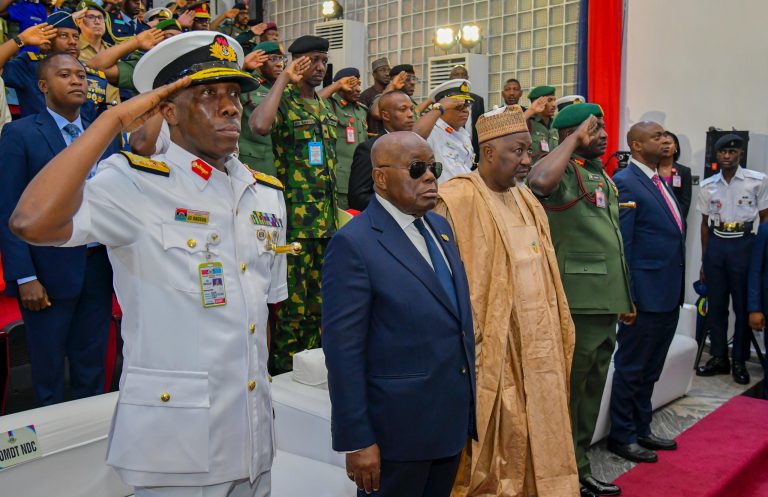
Former President Nana Addo Dankwa Akufo-Addo, has called on African leaders to prioritize the building of strong, independent institutions as the foun
Former President Nana Addo Dankwa Akufo-Addo, has called on African leaders to prioritize the building of strong, independent institutions as the foundation for good governance, sustainable development, and political stability on the continent.
He made the call while addressing the graduating officers of Course 33 of the National Defence College (NDC) in Abuja, Nigeria, on Monday, August 18, 2025.

Akufo-Addo, who served as Ghana’s president from 2017 to 2025, was invited as the guest speaker by Nigerian President Bola Ahmed Tinubu and the Commandant of the College, Rear Admiral James Ohimai Okuson.
The Ghanaian statesman used the platform to reflect on Africa’s governance journey since independence, identifying successes, persistent challenges, and potential pathways for reform.

Democracy and Institutional Reforms
The former president highlighted how countries such as Ghana, Nigeria, Kenya, Rwanda, Senegal, and Botswana have undertaken institutional reforms that have reshaped their governance systems.
In the case, he credited the 1992 Constitution for creating a framework of checks and balances that allowed for peaceful democratic transitions, including the electoral defeat of sitting governments.
“I stand here as a beneficiary of these reforms,” he noted, referring to his own 2016 electoral victory as opposition leader.
He also pointed to Nigeria’s anti-corruption institutions, including the Economic and Financial Crimes Commission (EFCC) and the Independent Corrupt Practices Commission (ICPC), as examples of initiatives that have strengthened transparency.
However, he admitted that despite such progress, governance deficits remain entrenched across the continent.
Governance Deficits: Corruption, Weak Institutions, and Insecurity
Akufo-Addo drew attention to findings from the 2024 Mo Ibrahim Index of African Governance, which showed gains in several countries but also a worrying decline in governance standards in parts of the Sahel, Sudan, and North Africa.
He said weak institutions, corruption, fragile democracies, and authoritarian tendencies continue to undermine Africa’s development.
Citing statistics, he underscored the scale of the challenges: adult literacy in sub-Saharan Africa stands at 67.7%, youth unemployment averages 34% across the continent, and health systems are weakened by underfunding and brain drain, with over 65,000 African-trained medical professionals working in OECD countries.
“Until governance rises to match the urgency on the ground, the health and dignity of millions will remain at risk,” he warned.

Rule of Law and Separation of Powers
Akufo-Addo stressed that genuine good governance can only thrive on the foundation of independent and effective institutions.
He identified the three arms of government — Executive, Legislature, and Judiciary — as essential pillars, but lamented their weaknesses in many African states.
According to him, executives in some countries wield excessive power, parliaments often serve as “rubber stamps,” and judiciaries are weakened by corruption and executive interference.
He cited Nelson Mandela’s assertion that an independent judiciary is the cornerstone of democracy, stressing that Africa must commit to judicial reforms that guarantee financial independence, merit-based appointments, and legal protections for judges.
Military and Security Governance
President Akufo-Addo also addressed the role of the military in Africa’s political and security architecture.
He recalled establishing the College of Defence Studies in 2023, granting it a Presidential Charter a year later, to build self-reliant defence leadership.
Emphasizing professionalism, he said coups become less likely when the military is loyal to the constitution, adequately remunerated, and backed by accountable civilian governance.
“A stable democracy in Africa depends on a professional, politically neutral military with fair pay, clear command, and a focus on serving the people,” he said.

AfCFTA and Economic Growth
Turning to Africa’s economic prospects, the former president urged countries to harness the opportunities of the African Continental Free Trade Area (AfCFTA), whose secretariat is located in Accra.
He observed that intra-African trade currently accounts for only 16% of the continent’s GDP, compared to 75% in the European Union.
Akufo-Addo urged Ghana and Nigeria — as regional anchors — to drive the AfCFTA agenda, which he said could transform youth unemployment, stimulate industrialization, and strengthen food security.
The Way Forward
The former Ghanaian president concluded by proposing a multidimensional strategy to strengthen governance: reducing corruption through independent oversight bodies, leveraging digital technology for transparency, investing in education to promote civic awareness, and deepening citizen participation.
He told the graduating officers that their role went beyond the battlefield. “You are not just soldiers; you are guardians of peace, defenders of the constitution, and symbols of integrity for your nation,” he said, urging them to hold fast to professionalism in the face of political pressures.
The ceremony, which celebrated the achievements of officers who had undergone 48 weeks of intensive training, was attended by senior Nigerian government officials, military leaders, diplomats, and invited dignitaries.

COMMENTS