
Chief Moomen’s Nkrumah Showboy Part 1: The Boy from Nkroful has received its main preview at Ghana’s National Theatre, presenting the early life of th
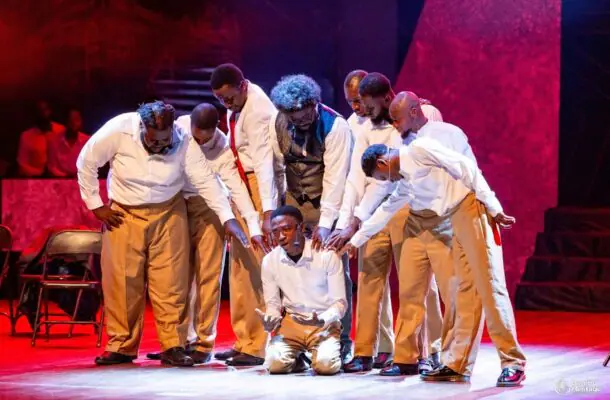
Chief Moomen’s Nkrumah Showboy Part 1: The Boy from Nkroful has received its main preview at Ghana’s National Theatre, presenting the early life of the country’s first president through grief, music and political awakening.
The performance on Friday, October 16th, followed an initial preview at NkrumahFest ’26 in Nkroful a month earlier. It draws heavily on Osagyefo Dr Kwame Nkrumah’s autobiography and ends with his return to the Gold Coast in 1947.
The production is built around Nkrumah’s words, “so much to do, so little time”. The refrain first appears after the young trainee teacher learns of his father’s death, before returning with greater force following the death of Dr Kwegyir Aggrey, his teacher and mentor at Achimota, then the Government Training College.
The contrast is intentional. The play portrays Nkrumah as more deeply affected by Aggrey’s death, presenting the two bereavements as an accumulation of loss in a short period.
That sense of urgency would later take on a political form through the Convention People’s Party slogan “Self-Government Now”. The CPP was formed in June 1949 after Nkrumah left the United Gold Coast Convention, whose stated objective was self-government in the shortest possible time. Moomen’s play traces that impulse back to 1927, when Nkrumah lost both his father and his father figure.
The audience at the National Theatre applauded scene changes but fell silent after each death, as the crowd in Nkroful had done. When the actor playing Nkrumah slowed and faltered around the refrain, the theatre responded with audible sighs.
The two-hour production features about 55 performers and crew members, including 30 actors and an eight-member band. Moomen wrote, directed and produced the work, following Mansa Musa and the Trail of Lost Gold in his effort to bring Ghanaian history to audiences through cultural storytelling.
The play gives the younger Nkrumah humour, uncertainty, defiance, grief and occasional impulsiveness rather than portraying him simply as the statesman he would become. His first act of rebellion, staged at primary school, provides one of the evening’s lighter moments.
At training college, Dr Kwegyir Aggrey’s arrival marks a gradual shift towards the more familiar political figure. The band’s music follows Nkrumah’s changing locations, using predominantly highlife for his Gold Coast years and Western influences for his time abroad.
The overseas sections include covers of Beenie Man’s “Gospel Time”, Shaggy’s “It Wasn’t Me” and Michael Jackson’s “They Don’t Care About Us”. At Nkroful, older audience members sang along to Meiway’s “200% Zoblazo” and Wizkid’s “Ojuelegba”, while younger spectators reacted more strongly to the choreography.
The final sequence uses Osibisa’s “Woyaya” and “Welcome Home” to depict Nkrumah leaving London and returning to the Gold Coast. Osibisa, founded in London by Ghanaian expatriates, provides the link between the two places.
Part 2 will cover Nkrumah’s activism, the independence struggle, his years in government, overthrow and death. Both parts are scheduled to be staged together in March 2027, after Part 1 has completed its own run.

COMMENTS